Pilates for Frozen Shoulder in Zhubei: Gentle Rehab Support Without Overstretching
September 14, 2026
Frozen shoulder can make even simple movements feel guarded and frustrating. I share how I use gentle Pilates support in Zhubei to help people move with more ease, without pushing too hard.
Pilates for Frozen Shoulder in Zhubei: Gentle Rehab Support Without Overstretching
When someone walks into Cozy Pilates and quietly says, “My shoulder feels stuck,” I usually know there has been a long stretch of waking up, trying to reach for a cup, pulling on a shirt, and feeling that stubborn little pull in the joint. Frozen shoulder can be exhausting in a way that is hard to explain unless you have lived it. It is not dramatic pain every second. It is the slow irritation of being reminded, again and again, that your body is not moving the way you want.
I have seen students in Zhubei come in with that careful look in their eyes. They keep the arm close to the body. They move the torso instead of the shoulder. They have already tried stretching on their own, often with too much force. That is where I slow everything down. With, my goal is not to chase range quickly. It is to create a safer conversation with the shoulder, the ribs, the neck, and the breath.
What frozen shoulder usually feels like
Frozen shoulder, or adhesive capsulitis, often brings a mix of stiffness and pain that can last for months. One of the things I notice most is how people begin to protect the shoulder without even noticing it. They lift the whole shoulder up. They twist the spine. They stop reaching behind the back. Sleep can get messy too. Lying on one side feels wrong, then turning over in bed becomes a little negotiation every night.
If you are trying, the first thing I would want you to know is this, pain is not a sign to push harder. For frozen shoulder, forcing a stretch often makes the body guard more. It can feel like you are “doing something useful,” but the next day the shoulder may feel tighter, warmer, and more defensive. I have watched that pattern many times.
How I approach gentle Pilates support
At Cozy Pilates, I work with the body in small pieces. Sometimes we start with breathing and rib movement before the arm does much at all. That might sound too simple, but it matters. When the ribs move well, the shoulder has more room to organize itself. When the neck is less busy, the arm does not have to carry all the work.
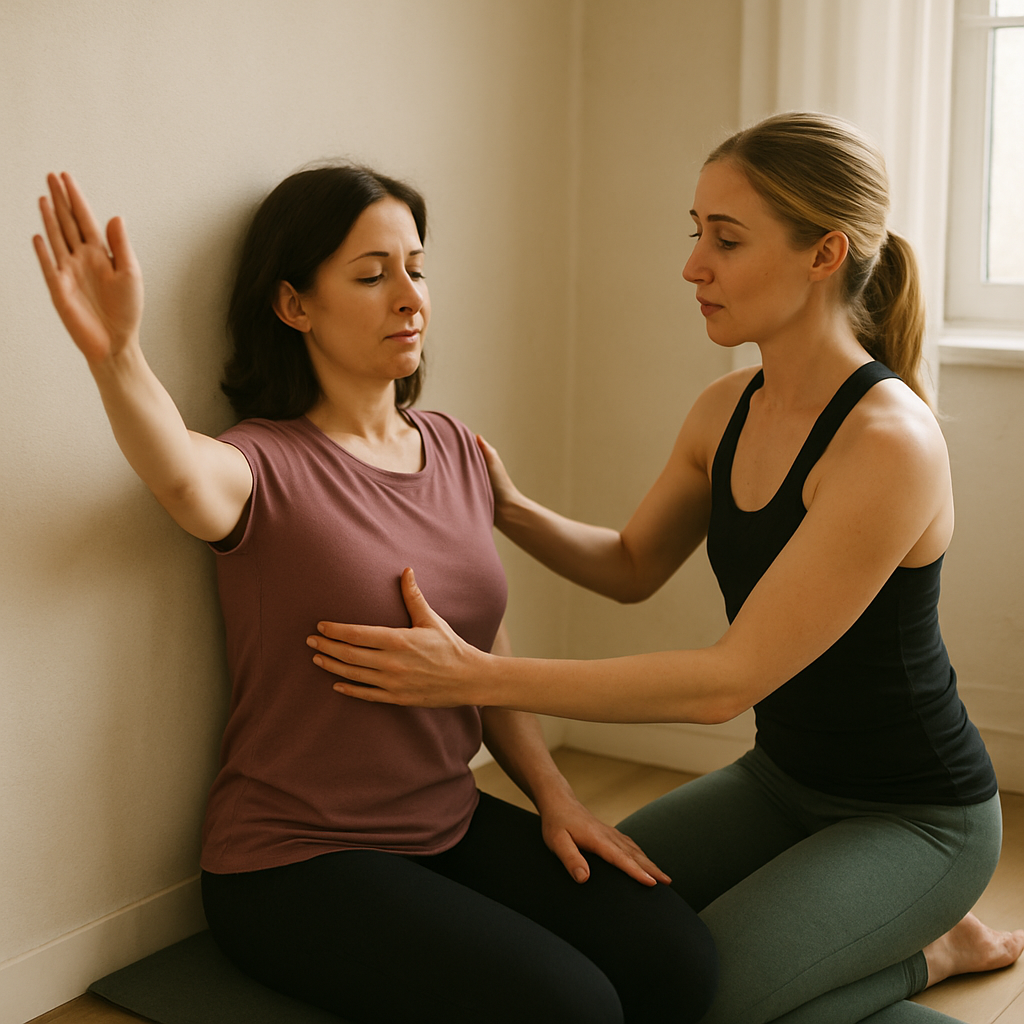
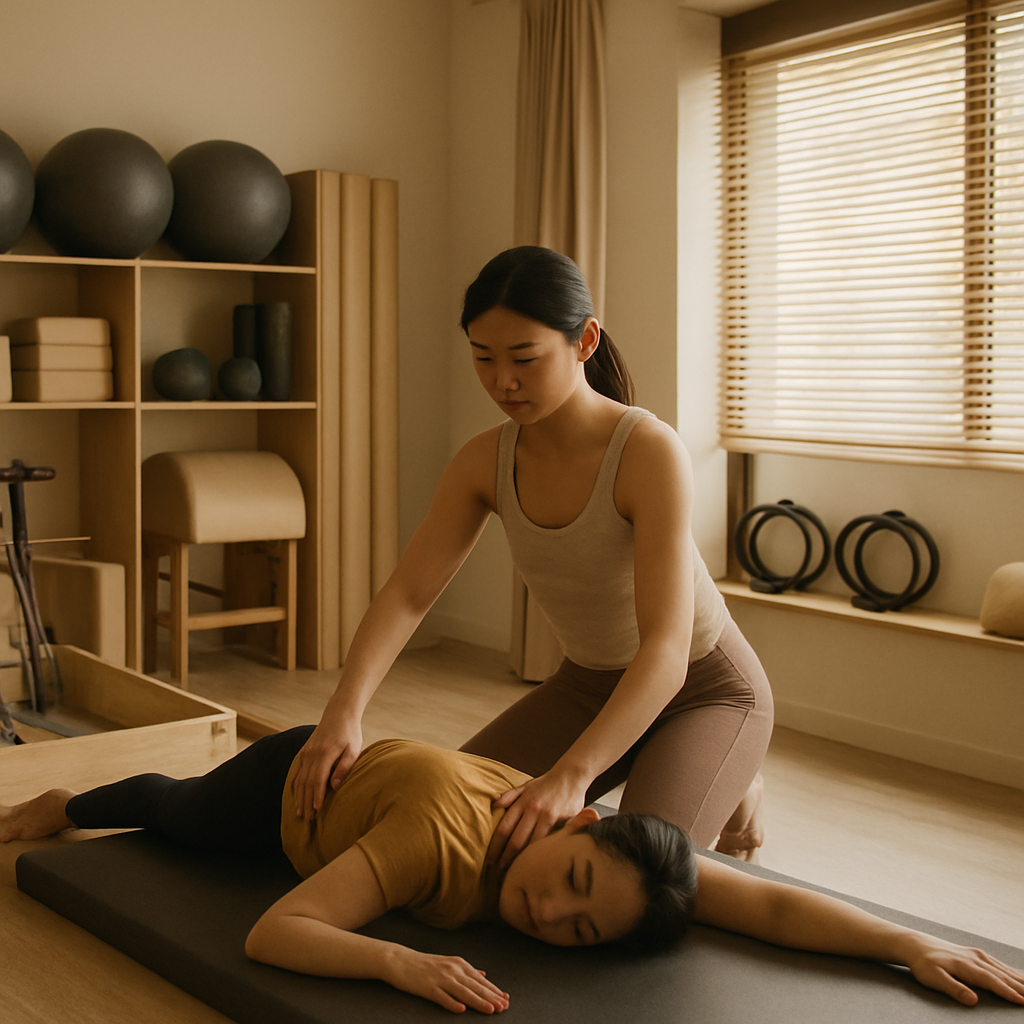
In a private session, I may choose supported arm circles, scapular awareness, gentle thoracic mobility, or mat work with props so the shoulder can move without feeling trapped. I pay close attention to the face, the breath, and the moment when a student starts to brace. That tiny change, a held breath, a clenched jaw, a lifted collarbone, tells me we need to soften the task.
For frozen shoulder, the useful feeling is usually mild effort, not deep strain. I say that often in the studio. If a movement makes the shoulder feel calmer and slightly warmer, that can be a good sign. If it creates a sharp pinch, a stronger ache later, or a feeling of being jammed, I step back. should support recovery, not add another layer of irritation.
Movements I often use, and what I avoid
People often ask me what exercises are “best.” I wish the answer were that tidy. With frozen shoulder, context matters. The same arm raise can feel okay one day and awful the next. Still, I often use:
Supported arm mobility with a ball, wall, or towel, so the shoulder does not carry all the load.
Scapula and rib coordination, because the shoulder blade and ribs need to talk to each other.
Gentle spinal rotation and extension, which can reduce the feeling that the upper body is locked in one piece.
Breath-led movement, especially when the student tends to guard.
I am much more cautious with aggressive overhead work, heavy resistance, long holds at end range, and anything that makes the student grimace through the last few reps. If a frozen shoulder is still very irritable, even a classic stretch can be too much. I would rather see a student leave feeling quieter in the body than impressed by how far they forced the arm to go.
Why private sessions help with frozen shoulder
Frozen shoulder is not a one-size-fits-all situation. Some people are in the painful early stage. Some are in the stiff, stubborn middle. Some are beginning to regain motion but still feel nervous about using the arm. This is one reason private sessions can be helpful. I can adjust the pace, the props, the range, and the dosage in real time.
At Cozy Pilates, many students begin with one-on-one sessions before joining a small group class. That gives me space to understand how their shoulder reacts after class, not just during it. Did the arm feel better later that day? Did it tighten after carrying groceries? Did sleeping on the affected side become worse? Those details guide everything. If you are looking for gentle rehab support in Zhubei, that kind of close attention matters.
You can also ask about our studio packages if you want a consistent schedule. For frozen shoulder, consistency often helps more than intensity. A little, repeated with care, tends to be kinder than one heroic session followed by three days of soreness.
How to know if Pilates is too much
This is the question I wish more people asked sooner. A little discomfort can be normal in rehab, but with frozen shoulder I watch for a few warning signs. Pain that climbs sharply during class. A shoulder that feels more stuck for the rest of the day. Heat, throbbing, or a protective spasm that lingers. Sleep that gets noticeably worse after the session.
If that happens, we reduce the range, change the prop, shorten the lever, or switch the exercise completely. There is no prize for pushing through. The shoulder does not learn safety from being bullied. It learns safety from repeated experiences of movement that feel controlled and possible.
If you have been searching for in Zhubei, I would love for you to think about Pilates as support, not punishment. The right session should leave you feeling more organized, a little more open, and not secretly bracing for the drive home.
If you want to know whether a private session, a small group class, or a slower return-to-movement plan is the right start, you can always reach out to Cozy Pilates studio. I am happy to look at where your shoulder is today, and work from there.