Pilates for Scoliosis in Zhubei: What It Can and Can’t Do
September 6, 2026
Living with scoliosis can feel confusing, especially when your body seems to change from week to week. I share what scoliosis Pilates can support, what it cannot fix, and how I approach it with care at Cozy Pilates.
What I mean when I say scoliosis Pilates
I still remember the first time a student stood in front of me and said, very softly, that one shoulder always looked higher in photos. She had already heard many opinions. Some people told her to stretch more. Some said to stop exercising altogether. She looked tired before we even started moving.
That is often where scoliosis Pilates enters the picture. Not as a promise. Not as a miracle. As a thoughtful way to work with a body that may feel uneven, rotated, tight on one side, and strangely unstable on the other.
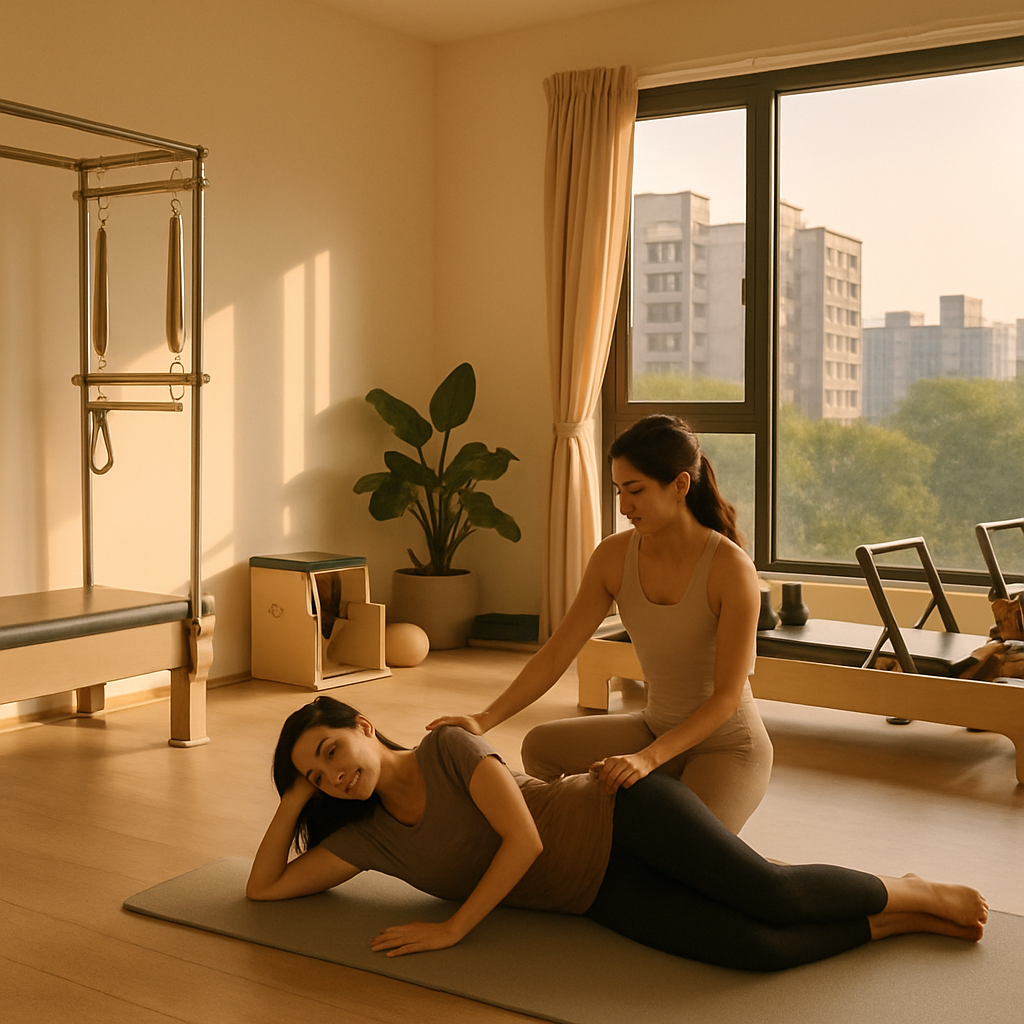
In my studio in Zhubei, I do not treat scoliosis as a label that decides everything. I look at the person in front of me, how they breathe, how they stand, how one rib cage feels different from the other, how they move when no one is correcting them. Sometimes the movement story is gentle. Sometimes it is full of guarding and hesitation.
What scoliosis Pilates can support
Scoliosis Pilates can help you build better awareness of your own alignment. That sounds simple, but for many people it is the first time they notice how they shift weight into one hip, clamp one side of the rib cage, or hold the breath when the body feels uncertain.
It can also support smoother breathing. I pay close attention to that. When the ribs are shaped differently, breathing may feel lopsided or shallow. We work slowly, with props when needed, so the person can feel where the breath actually goes instead of forcing big chest expansion.
Another thing it can do is improve control. Not perfect symmetry, because that is rarely the real goal. I mean control in the practical sense. Getting up from the floor with less wobble. Reaching overhead without gripping the neck. Walking out of the studio feeling a little more organized inside the body.
For some students, it also reduces the feeling of stiffness. I have seen people arrive after long office hours in Hsinchu Science Park with that familiar one-sided tension through the low back and side waist. After careful work, they often say they feel taller, or simply less compressed. I like those small words. They are honest.
What scoliosis Pilates cannot do
I want to be very clear here. Scoliosis Pilates cannot promise to straighten the spine. It cannot replace medical evaluation when pain is sharp, worsening, or unusual. It cannot tell you the exact angle of your curve, and it cannot decide whether you need bracing, physical therapy, or another kind of treatment.
It also cannot make every body look balanced in the mirror. Some curves are structural. Some are flexible. Some bodies will always have visible differences in shoulder height, waist shape, or rib prominence. Pilates does not erase those realities.
What it can do is give you more room to move with less fear. That matters a lot to me. When a person stops bracing against their own body, the whole session changes. They breathe. They feel. They learn where effort helps and where effort is just extra tension.
How I work with scoliosis at Cozy Pilates
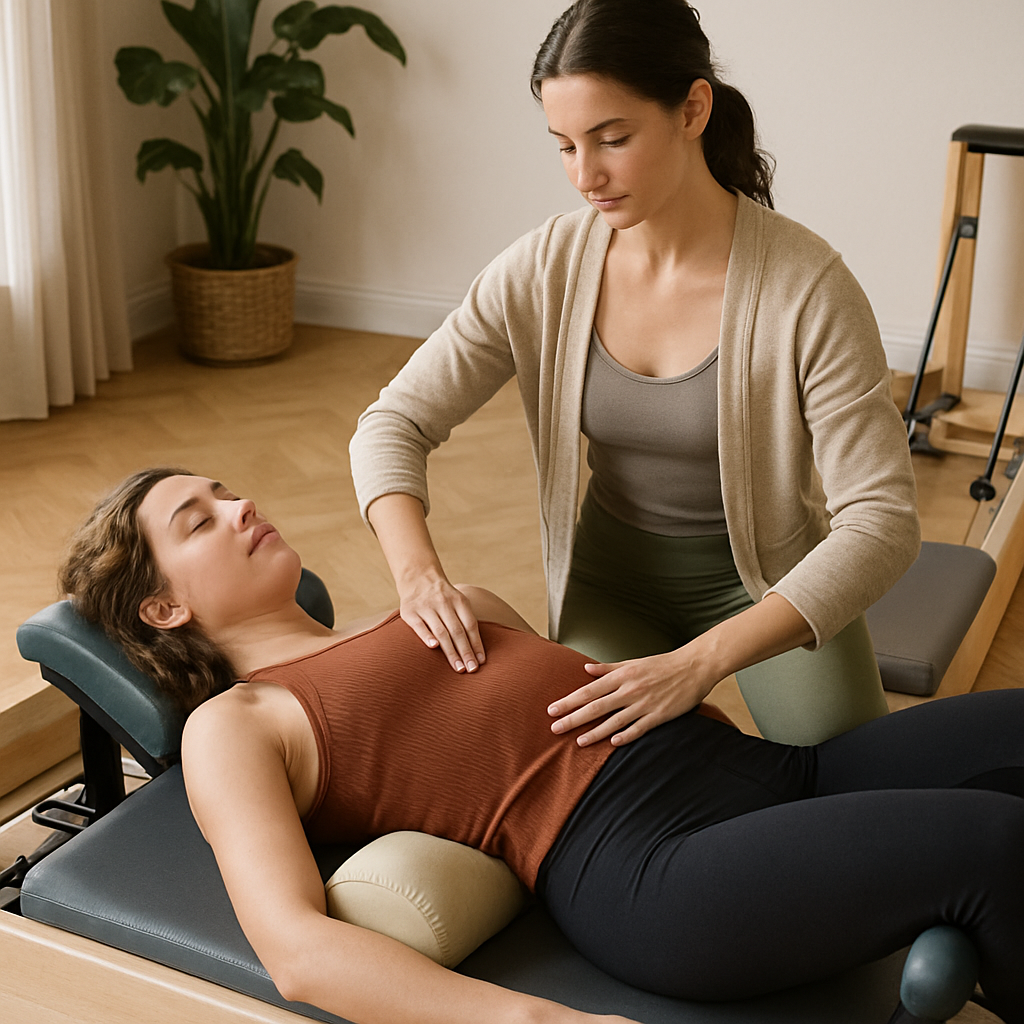
At Cozy Pilates, I start with observation, not assumptions. I ask about pain, old injuries, daily habits, and the moments that make the body complain. Then I watch standing, breathing, rolling, reaching, and the small transitions that reveal much more than a textbook posture picture ever could.
From there, I choose exercises that suit the person in front of me. Sometimes that means more support from the mat, chair, or springs. Sometimes it means simplifying the work so the nervous system can settle. Sometimes I take away range and ask for clarity instead. A smaller movement, done well, can teach the body a lot.
My favorite sessions are the ones where a student suddenly notices, almost with surprise, that one side of the ribs can soften. Or that the pelvis does not need to grip so hard. Those moments are quiet. No applause. Just a little exhale, and the face changes.
If you are looking for a studio that can adapt to you, this is where I think scoliosis Pilates makes sense. We can work through private sessions, and for some people semi-private classes are a good fit when the program is carefully chosen. If you are unsure, a first assessment session is usually the best place to begin.
Who should be careful, and when to ask for medical advice
If your pain is new, sharp, radiating, or linked to numbness, weakness, or changes in bladder or bowel function, please see a medical professional first. I mean that sincerely. A Pilates studio should never be the first stop for those warning signs.
If you already have a scoliosis diagnosis and your doctor or therapist has given you guidance, bring it with you. I like working alongside that information. It helps me keep the session specific instead of guessing.
And if you are simply curious, that is fine too. Many people come to me because they want to understand their body better, not because something is terribly wrong. That is a good reason to start.
What I hope you feel after a session
I do not need you to leave the studio perfect. I hope you leave more aware, less guarded, and a little kinder toward the shape you live in.
That is the heart of scoliosis Pilates for me in Zhubei. Not a fix-all. Not a sales pitch. A careful conversation with the body, one breath and one movement at a time.
If you want to try this in person, you can ask about our private sessions, beginner-friendly classes, or studio packages at Cozy Pilates. I am always happy to help you find the right starting point.