Pilates for Rib Cage Flare and Abdominal Pressure in Zhubei
October 28, 2026
If your ribs lift when you breathe, brace, or do core work, Pilates can help you find more support without squeezing hard. I see this often in the studio, especially in people who feel pressure in the belly or lower back.
What I notice when the ribs keep popping up
In the studio, I often see people arrive with a familiar shape in the body. The lower ribs sit forward. The front of the belly feels pressurized. The neck works too hard. Sometimes the person has already tried to “hold in the core” for months, maybe years, and that effort has only made everything feel tighter.
This is where rib cage flare matters. It can show up when the ribs stay lifted at rest, or when they shoot up during breathing, bridging, planks, or even just standing. I usually think less about appearance and more about what the body is doing underneath. Can the ribs settle over the pelvis? Can the breath widen without pushing the belly forward? Can the front body soften enough to let the deep support system actually work?
At Cozy Pilates in Zhubei, I meet many people who describe abdominal pressure in very different words. One says, “My stomach feels like it is being pushed out.” Another says, “I cannot feel my abs unless I squeeze really hard.” Someone else tells me their lower back gets tired before their core does. Same pattern, different story.
Why rib cage flare and abdominal pressure often travel together
The ribs and pelvis are part of the same pressure system. When the ribs stay lifted, the diaphragm cannot move as freely. Breathing becomes high and shallow. Then the abdominal wall often tries to stabilize by bracing from the outside instead of organizing from the inside. That can create more pressure in the front of the belly, and sometimes more strain in the low back too.
I see this a lot in people who sit for long hours, in new mothers rebuilding after pregnancy, and in students who are very strong on paper but feel disconnected from their center. They know how to work hard. They just do not always know how to spread the effort across the whole trunk.
In Pilates, I like to slow this pattern down. Not because it is weak, but because it needs coordination. The goal is not to flatten the ribs with force. The goal is to help the ribs stack more easily over the pelvis, so pressure can move and distribute instead of getting stuck in the front body.
What I do first in Pilates for rib cage flare
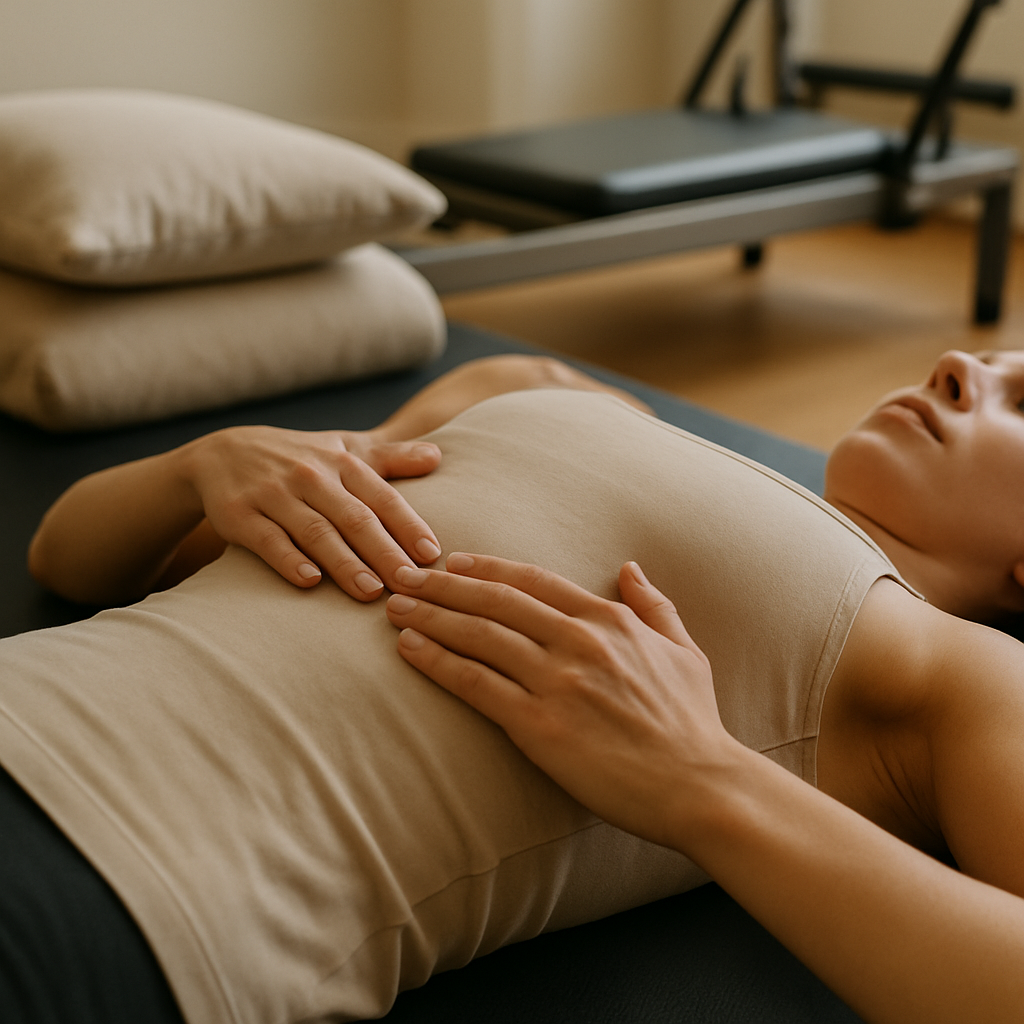
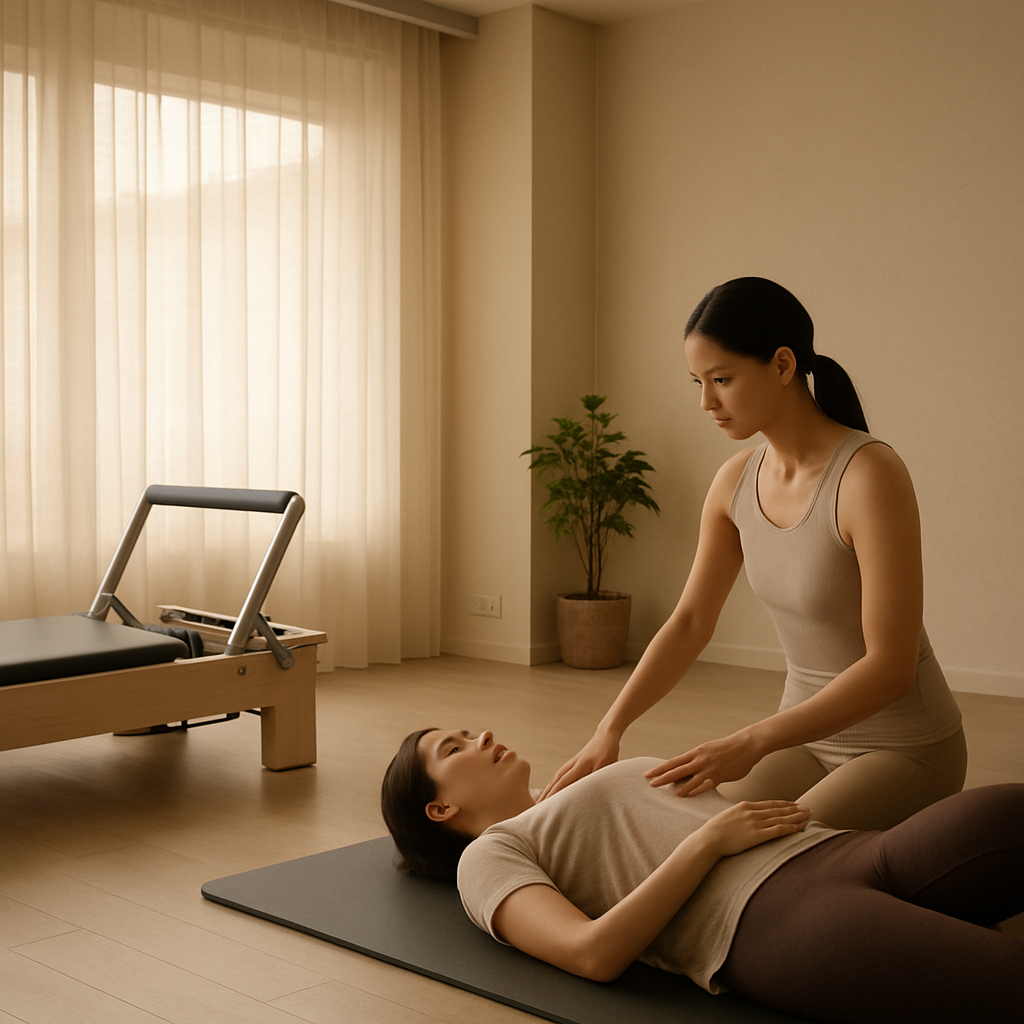
I usually begin with breathing. Simple, yes. But the way someone breathes tells me almost everything. I may ask a student to lie on the mat, bend the knees, and place their hands around the lower ribs. Then I watch. Do the ribs expand sideways? Do they lift immediately into the chest? Does the belly harden before the exhale finishes?
From there, I often use small Pilates exercises that feel almost quiet. Heel slides. Dead bug variations. Bent-knee arm work. Side-lying breathing. These are not flashy movements, but they are useful because they give the nervous system a chance to notice, “Oh, I can breathe and support myself without gripping.”
One of my favorite cues is very simple. I ask people to imagine the ribs melting down into a soft sweater, while the back ribs keep widening into the mat. It sounds poetic, maybe a little strange, but the body usually understands it better than a technical lecture.
How Pilates helps abdominal pressure without over-bracing
Many people try to solve abdominal pressure by pulling everything in harder. I understand why. That strategy feels active. It feels responsible. But too much bracing can increase pressure downward or forward, especially if the breath gets stuck high in the chest.
In Pilates, I look for three things: breath that can move, ribs that can settle, and deep abdominal support that turns on without panic. This often means working at a smaller range first. It may also mean changing the exercise entirely for a while. A full teaser is not helpful if a simple leg reach already makes the ribs fly up.
Sometimes I use props. A folded towel under the head. A pillow under the knees. A light band around the ribs for feedback. These little tools are not “easier” in a lazy way. They are there to help the body find the right information.
If you are dealing with abdominal pressure, I also pay attention to pressure habits outside the studio. Do you hold your breath when lifting your child? Do you brace before standing up from the sofa? Do you push through workouts even when the front of the belly feels heavy? Small daily habits matter a lot.
What a session at Cozy Pilates in Zhubei can feel like
People often expect Pilates to be loud and intense. Some days it is challenging, yes. But many of the most useful sessions are surprisingly calm. You might hear the soft roll of the mat, the small click of the reformer carriage, my voice asking you to exhale a little longer, and the pause after a movement when your body finally has time to register what changed.
I like that pause. That is where learning happens.
For someone with rib cage flare, the session may include breathing in side lying, pelvic organization on the mat, footwork on the reformer, and slow coordination work that teaches the ribs not to lead every movement. For someone with more abdominal pressure, I might reduce load, simplify range, and rebuild confidence from the ground up.
If you are local, this is also why I always say the best plan is personal. A private session, a small group class, or a more structured package can all support the work in different ways. Some students need one-on-one attention first. Some are ready to join group classes once they know what to feel for. The right choice depends on the body in front of me, not a fixed formula.
Signs Pilates may be helping
The changes are often subtle at first. The ribs do not spring open quite as fast during movement. The belly feels less tense in the middle of the day. The low back is quieter after standing or walking. Breathing feels wider in the back and sides, not just in the chest. And maybe the biggest sign, the one I love seeing, is that the student stops forcing everything.
That shift takes time. It is not dramatic. It is more like the body exhaling after holding its breath for too long.
If you are searching for support in Zhubei, I would start with curiosity rather than correction. Notice how you breathe. Notice where you brace. Notice which movements make the pressure worse, and which ones give you a little more room. That information is already a beginning.
If you want a place to work on this gently, Cozy Pilates offers private sessions, small group classes, and packages designed to meet you where you are. I like to build from there, one breath and one honest movement at a time.