Pilates or Yoga for Back Pain in Zhubei? What Actually Works
March 26, 2026
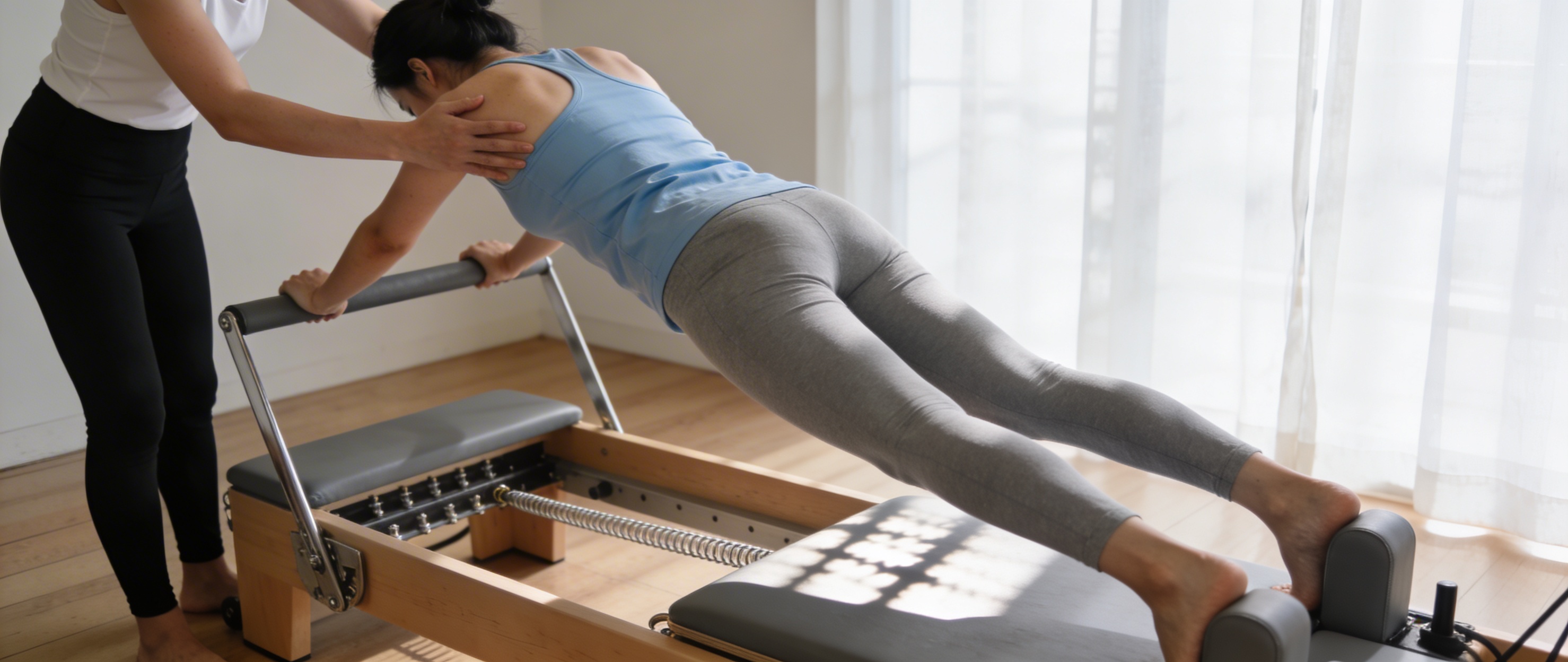
Struggling with back pain in Zhubei? Compare Pilates and Yoga to see which approach improves core support, posture, and long-term relief more effectively.
Pilates or Yoga for Back Pain in Zhubei? What Actually Works
Back pain changes how you move. It changes how you sit, how you sleep, how long you can focus at your desk. And once it lingers for weeks or months, you start searching for answers.
In Zhubei, the two most common options people compare are Pilates and Yoga.
Both look controlled. Both claim to help. Both have loyal followers who swear by them.
So which one actually works for back pain?
It depends on why your back hurts in the first place.
Why Most Back Pain Isn’t Just “Tightness”
When someone says, “My back feels tight,” stretching seems like the obvious solution.
And sometimes it helps.
But many cases of back pain — especially from desk work — aren’t simply about tight muscles. They’re about imbalance.
Often the lower back hurts because:
The hips are stiff.
The deep core activates too late.
The rib cage sits too high.
The pelvis tilts forward or backward.
The thoracic spine barely moves.
When those pieces don’t coordinate well, the lower back compensates.
That’s when pain becomes repetitive.
How Yoga Helps Back Pain
Yoga is excellent at improving mobility.
If your back pain comes from stiffness — especially in the hips, hamstrings, or upper back — consistent yoga can reduce tension and increase range of motion.
Breathing practices in yoga can also reduce overall muscular guarding. Many people feel immediate relief after class because their nervous system relaxes.
For mild, stress-related tightness, yoga can absolutely be effective.
But here’s the limitation.
Yoga improves flexibility. It doesn’t always retrain load distribution.
If your back hurts because it’s overworking for weak stabilizers, stretching alone may not solve it.
How Pilates Approaches Back Pain
Pilates — especially Reformer Pilates — focuses heavily on deep stabilizing muscles.
Instead of asking, “Where can we stretch?” it asks, “Why is the back doing too much?”
Sessions typically target:
Deep core timing.
Pelvic alignment.
Hip stability.
Controlled spinal articulation.
Balanced muscle activation.
The springs on the Reformer provide feedback. If one side collapses or the core fails to support, it’s immediately noticeable.
This makes Pilates particularly effective for chronic, recurring back pain.
The Office Worker Reality in Zhubei
Many clients in Zhubei sit long hours. Tech jobs. Desk jobs. Meetings. Screens.
This lifestyle often creates:
Rounded shoulders.
Anterior pelvic tilt.
Weak glutes.
Overactive lower back muscles.
In these cases, strengthening the right muscles and correcting alignment tends to provide more durable relief than stretching alone.
That’s why Pilates often produces longer-lasting change for posture-related back pain.
Which Should You Choose?
If your back pain feels primarily like stiffness and improves quickly after stretching, yoga may be enough.
If your pain returns regularly, especially after sitting or lifting, and feels structural rather than just tight, Pilates may address the root cause more effectively.
Some people combine both. Yoga for mobility. Pilates for stability.
But if you must choose one for chronic posture-related back pain in Zhubei, Pilates often offers more targeted correction.
If you’d like to explore Reformer Pilates for back pain relief in Zhubei, you can review available sessions here:
https://cozypilates.com/en/packages