Reformer Pilates in Zhubei: How Better Breathing Reduces Back Pain & Improves Spine Alignment
February 2, 2026
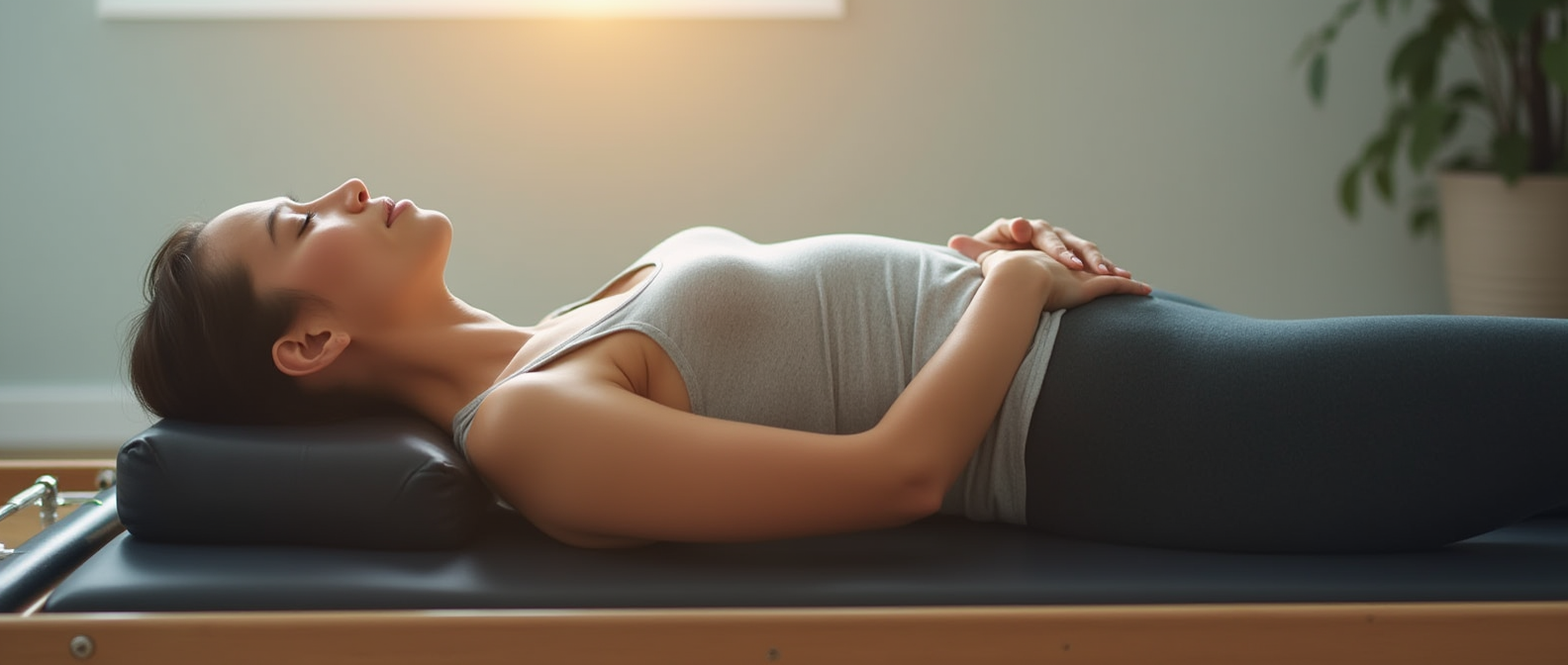
Discover how Reformer Pilates in Zhubei uses breath training to reduce back pain, improve posture, and restore deep-core support through one-on-one guidance.
Reformer Pilates in Zhubei: How Your Breathing Shapes Your Back
Most people never think about breathing until something hurts—usually the back. In our Zhubei studio, it’s almost a pattern: someone arrives with lower-back tension, a stiff neck, or ribs that won’t relax, and before they even start moving, you can see their breath sitting high in the chest like it’s been stuck there for years.
It’s not their fault.
Life gets busy. Stress builds. Shoulders creep up.
And somewhere along the way, breathing becomes a survival habit instead of a supportive one.
What most people don’t know is that how you breathe determines how your spine behaves.
Why Bad Breathing Leads to Back Pain
If breath stays trapped in the upper chest, the ribs stiffen, the diaphragm stops moving well, and the deep core turns quiet. Suddenly the lower back—already tired from sitting or standing long hours—takes on jobs it shouldn’t have to do.
Common patterns we see in Zhubei clients include:
- Shallow chest breathing → ribs lift & spine compresses
- Weak diaphragm movement → core can’t support the lumbar spine
- Tight upper back & shoulders → breath gets blocked
- Overactive lower back muscles → compensating for a quiet core
This creates a cycle where the breath and spine keep irritating each other.
How Reformer Pilates Resets Your Breathing (and Your Back)
Reformer Pilates is uniquely good at exposing how you breathe. The moment you lie on the carriage, your ribs, diaphragm, and lower back tell the truth. You can feel where the breath goes—and where it refuses to go.
Clients often notice right away:
- Their breath finally reaches the side ribs, reducing neck tension
- Their pelvic floor and diaphragm coordinate instead of fighting each other
- The lower back stops gripping when the core actually activates
- Movements feel lighter because breath supports the spine
- Posture changes without forcing anything
When breathing improves, stability returns. When stability returns, back pain loses its fuel.
Why Breath Is the Foundation of Core Strength
People often think “core work” means crunches or planks, but real core control starts with breath:
- The diaphragm descends
- The pelvic floor responds
- The deep core activates
- The spine aligns naturally
This is the internal pressure system that stabilizes the back. Without it, no amount of core exercises will stick.
Pilates Movements That Transform Breathing & Back Pain
1. Rib Breathing on the Reformer
Teaches lateral expansion and reduces upper-chest tension.
2. Pelvic Clock + Breath
Improves coordination between pelvis, diaphragm, and lumbar spine.
3. Footwork with Breath Cues
Shows how inhaling and exhaling affect hip mobility and spinal load.
4. Short Box Round/Flat Back
Reveals how breath can create true spinal support.
5. Swan Prep with Diaphragm Focus
Opens the thoracic spine and frees stuck rib mechanics.
When the Breath Changes, Everything Else Follows
The most surprising thing for many clients is this:
back pain drops not because they stretched more, but because they breathed differently.
Breath is the remote control for the spine.
Pilates teaches you how to use it.
If you’re in Zhubei and want to understand how breathing can relieve your back pain and reset your posture, you can explore our one-on-one Reformer sessions here:
Book a class at Cozy Pilates.